E-commerce Solutions in Multan | Professional Online Store Development
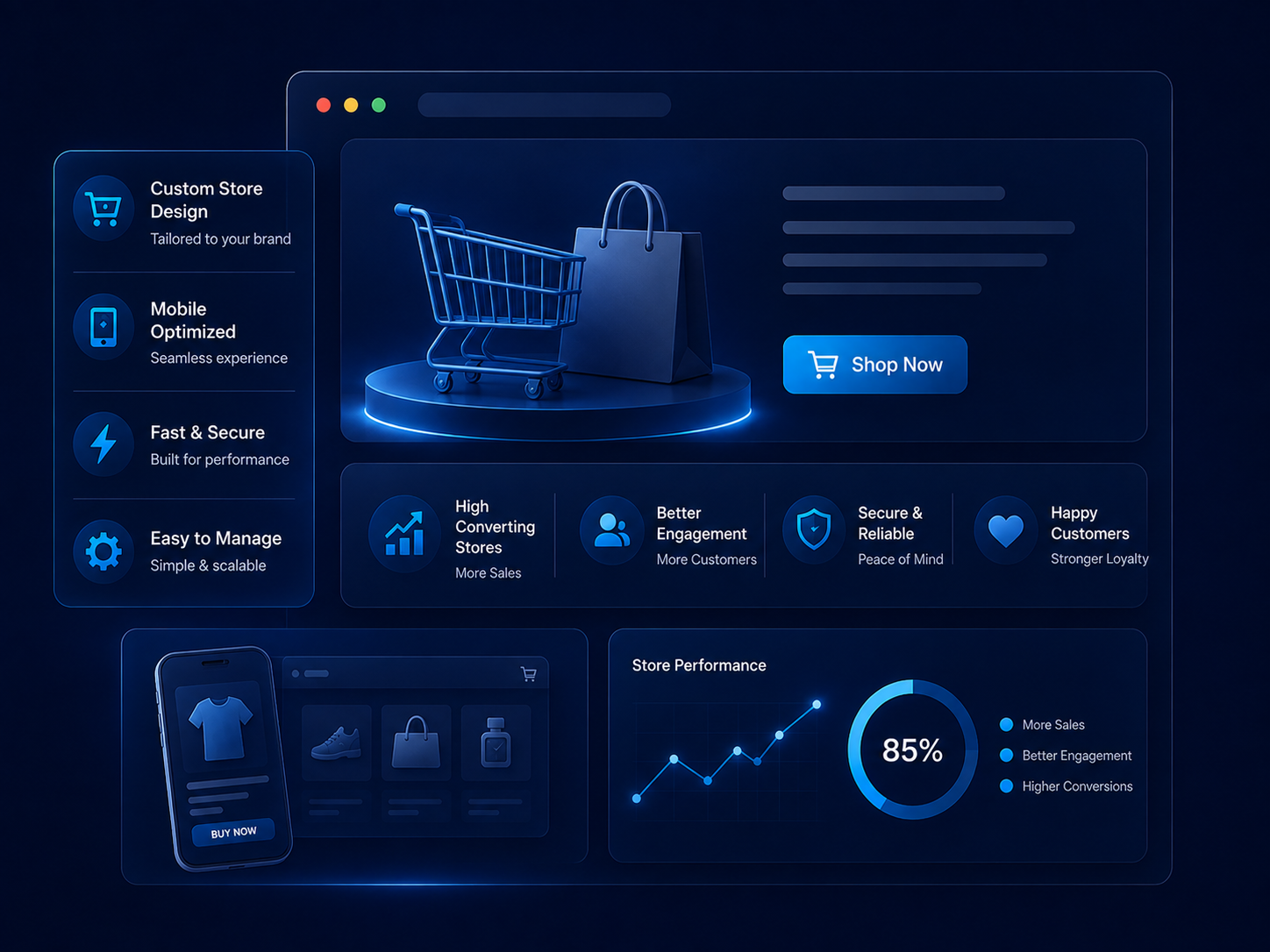
Optimized for speed and security
Looks great on all devices
Built for higher rankings

E-commerce Website Development Services in Multan
Our e-commerce development services include custom e-commerce website development, WooCommerce, Shopify, e-commerce website design services, migration or redesign, product catalogues, cart and checkout, payment setup, SEO foundations and required integrations. Each part is scoped around the business rather than sold as a fixed feature list.
WooCommerce development in Multan suits businesses that want WordPress-based store management and greater control over hosting, extensions and content. Shopify development in Multan can suit merchants who prefer a hosted commerce platform. Custom online store development is considered when a standard platform cannot support the required workflow cleanly.
E-commerce Stores We Build
Small Business Online Stores
Retail E-commerce Stores
Retail stores often need categories, filters, product variations, stock handling, promotional pricing and mobile-first browsing so shoppers can compare and buy efficiently.
Product-Based Brand Stores
B2B E-commerce Websites
Multi-Product Online Stores
Large product ranges need consistent categories, attributes, filters, SKUs and product relationships so customers can find items and the business can manage stock accurately.
Custom E-commerce Platforms
Design Your Online Store Around How Customers Actually Buy
Helping Customers Find the Right Product
Categories, search, filters, attributes, sorting and related products should reflect how customers compare the products being sold, not how the backend happens to store data.
Reducing Product Uncertainty
Product pages should answer purchase questions with useful images, specifications, variations, stock status, delivery details, returns information, reviews and relevant FAQs.
Reducing Checkout Friction
Checkout should request only the information needed to complete and fulfil the order, while showing pricing, shipping details, payment choices and form errors clearly.
Supporting Repeat Purchases
Where repeat orders matter, customer accounts, order history, reordering and relevant follow-up can support retention without adding unnecessary steps for first-time buyers.

What Should Be Automated in an E-commerce Website?
Automation should reduce repetitive work, improve accuracy or shorten the time between an order event and the next required action. It should support a defined process rather than hide a disorganized one.
Order Management
Order, payment and fulfilment statuses should move through a clear workflow so the team can see what requires action and customers receive the right updates.
Inventory Updates
Customer Notifications
Notifications should explain what happened, what happens next and whether the customer needs to take action, rather than sending vague system messages.
Business Integrations
Reporting
What Happens After a Customer Places an Order?
The e-commerce journey continues after payment. A working process should cover confirmation, payment verification, fulfilment, delivery, customer communication, returns or exchanges and support.
Order Confirmation
Customers should receive a clear order confirmation, while the store records the order in the correct status for the next internal action.
Payment Verification
Order Fulfilment
Delivery Tracking
Tracking can be added where the selected courier or integration supports it, but the exact workflow should be verified before publication or implementation.
Returns and Exchanges
Customer Support
E-commerce Website Architecture for Growing Product Catalogues
Catalogue architecture becomes more important as product count grows. Consistent product data supports better navigation, inventory control, SEO and future scalability.
Product Categories and Subcategories
Categories should group products by meaningful customer and business relationships. Subcategories are useful only when they make a large choice set easier to navigate.
Product Attributes and Variations
Attributes such as size, colour, capacity or material can support filtering and variations. Consistent attributes improve both customer selection and product administration.
SKU and Inventory Structure
SKUs should follow a consistent rule so products and variations can be identified reliably across the website, stock process and any connected systems.
Filters and Faceted Navigation
Filters should use attributes customers actually care about, while faceted navigation needs SEO controls so filter combinations do not create unnecessary crawlable URL states.
Product URL and SEO Structure
Product and category URLs should remain consistent, with crawlable navigation and internal links that expose important catalogue pages without relying only on on-site search.
Handling Large Product Catalogues
Large catalogues need repeatable rules for imports, categories, attributes, images, stock and discontinued products because inconsistent data becomes harder to correct at scale.

What Happens After a Customer Places an Order?
The e-commerce journey continues after payment. A working process should cover confirmation, payment verification, fulfilment, delivery, customer communication, returns or exchanges and support.
| Factor | WooCommerce | Shopify | Custom Development |
|---|---|---|---|
| Model | Open-source e-commerce on WordPress | Hosted commerce platform | Built around project requirements |
| Management | WordPress/WooCommerce admin; hosting and extensions require management | Central hosted store admin with platform-managed infrastructure | Depends on the admin tools developed |
| Customization | Flexible through themes, plugins and development | Themes, apps and platform-supported customization | Highest control when custom work is justified |
| Best fit | Businesses wanting WordPress integration and technical flexibility | Businesses preferring a hosted commerce environment | Workflows standard platforms cannot support cleanly |
Which e-commerce platform is best for a small business? It depends on catalogue complexity, integrations, management preferences, budget and future plans. Should I use WooCommerce or Shopify for my online store? The answer should come from those requirements, not from an agency preference.

E-commerce Solutions for Businesses in Multan and Pakistan
E-commerce solutions in Pakistan should reflect the target customer and operating model. For Multan businesses, that can include mobile-first purchasing, clear communication, suitable payment choices, practical delivery information and the ability to sell nationwide where the business supports it. A Multan seller may serve local customers while shipping to other cities, so the website may need to handle delivery expectations, stock, service areas and customer support consistently. Urdu or English content can be used where it helps the audience, but payment, courier and language claims should be verified for the specific project.
E-commerce Features That Help Turn Visitors Into Customers
Conversion features should remove real decision barriers. The most useful features help customers find products, understand them, trust the transaction and complete the next step.
Product Search and Filtering
Search should return relevant products for common terms, while filters should use meaningful attributes rather than exposing every piece of backend data.
High-Quality Product Pages
Reviews and Social Proof
Trust and Security Signals
Cart and Checkout Optimization
Mobile Shopping Experience
Mobile Shopping Experience
SEO-Friendly and High-Performance E-commerce Development
SEO-friendly development helps search engines reach and understand important products and categories while keeping the store useful for customers. It begins with architecture, not after the catalogue is already published.
Product Page SEO
Product pages need a clear purpose, descriptive titles, useful content, structured headings and crawlable text rather than duplicated manufacturer descriptions across the catalogue
Category Page Structure
Category pages should group related products and provide enough context to explain the group without pushing products down with repetitive SEO copy.
Crawlable Navigation
Navigation, category links, breadcrumbs and contextual internal links should expose important store pages without depending entirely on search boxes or dynamic filters.
Structured Data Readiness
Development should support appropriate structured product information where the platform and visible page content qualify, with markup that accurately matches what users can see.
Image Optimization
Product images should balance quality with file size and use descriptive filenames or alternative text where appropriate, while consistent dimensions support stable layouts.
Core Performance Considerations
Hosting, themes, apps, plugins, images, scripts and custom functionality all affect performance, so optimization should target actual bottlenecks instead of relying on one score.
Mobile Performance
Mobile performance should be tested separately because heavy media, scripts and complex interfaces can affect smaller devices and slower connections differently.
Internal Linking Between Products and Categories
Related products, parent categories, breadcrumbs and contextual links can help users move through the catalogue while reinforcing page relationships for search engines.
Secure E-commerce Website Development
Secure e-commerce development uses layered controls rather than absolute promises. Depending on the platform, this can include HTTPS, secure authentication, access control, payment integration, software updates, backups and customer-data protection. Hosted and self-hosted platforms divide infrastructure responsibility differently, so maintenance should match the selected platform. Store owners also need strong credentials, limited administrator access and a process for removing access when it is no longer needed. No website should be described as completely risk-free; the practical goal is to reduce avoidable risk and maintain a recovery path.
Our E-commerce Website Development Process
Professional e-commerce website development works best when product and operational requirements are defined before design. Our process keeps platform, catalogue, checkout and post-launch responsibilities visible from the start.
Business and Product Requirements
We define products, catalogue size, target customers, order workflow, payment methods, delivery process, account needs, integrations and any existing store data that must be preserved.
Platform Selection
Store Architecture and Product Structure
UX/UI Design
Development
Payment and Third-Party Integrations
Testing
Launch
Post-Launch Support
How Much Does an E-commerce Website Cost in Multan?
E-commerce website cost in Multan depends on product count, platform, design complexity, customer accounts, payment and shipping requirements, APIs, automation, migration and custom functionality. A useful estimate starts with scope rather than one fixed price.
| Store Type | Typical Scope Drivers |
|---|---|
| Small Store | Focused catalogue, standard product pages, cart, checkout and core setup |
| Growing Store | Larger catalogue, filters, integrations, automation and ongoing operations |
| Custom Store | Special workflows, APIs or custom functionality |
| B2B Store | Accounts, permissions, pricing rules or trade ordering |
How long does it take to build an e-commerce website? Timing depends on the same scope factors plus product-data readiness, approvals, integration complexity and testing. Providing product count, payment methods, delivery process and existing systems makes both cost and timeline estimates more reliable.
Why Choose Our E-commerce Solutions in Multan?
An e-commerce development agency in Multan should explain how the store will support products, customers, orders and operations, not only which theme it will use. Our approach keeps business requirements, customer journey, catalogue structure, SEO and post-launch management connected.
Business-First Store Planning
We start with the business model, products, customers and order workflow so the technical scope reflects the work the store must perform.
Customer Journey-Based Architecture
SEO-Ready Development
Performance-Conscious Implementation
Scalable Product Architecture
Post-Launch Support
Frequently Asked Questions
How much does an e-commerce website cost in Pakistan?
Cost varies by platform, product count, design, catalogue complexity, integrations, payment and shipping requirements, migration, automation and custom development. A small standard store requires less work than a B2B or custom platform.
How long does it take to build an online store?
Timeline depends on scope, product data, design approvals, integrations, platform complexity and testing. It should be estimated after the requirements are confirmed.
Should I use WooCommerce or Shopify?
Can you build a custom e-commerce website?
Can you integrate payment gateways?
Can you migrate an existing online store?
Can I manage products and orders myself?
Yes. WooCommerce and Shopify provide store administration for products and orders, with the exact workflow depending on the platform and user permissions.
Can you build an e-commerce website for a small business?
Can an e-commerce website be optimized for Google?
Do you provide website maintenance after launch?

Your Go-To Web Developer & SEO Expert in Multan – Let’s Build Your Digital Success Together!
Our Services
All Rights Reserved | Copyright © 2026 | Web Developer in Multan | Owned By Inno Web Sols